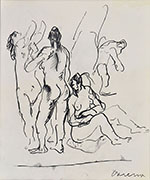
Cumiana (TO), 1879 - Venice, 1966
Carena trained at the Accademia Albertina in Turin, as a pupil of Grosso and and from the start he addressed himself to the secessionist and symbolist approaches, developing a predilection for the intimism of the French artist Eugène Carrière, but also displaying an interest in Boecklin and, during his only visit to Paris while he attended the Academy, studying the works of Courbet. In 1906 he was awarded a national art prize for his painting La Rivolta – a grant to live and work for four years in Rome, where he remained for a long time. During the First World War from 1915-1918 he was an officer in the artillery; then, in 1919, he returned to Turin to exhibit his painting Contadini al sole, which is on show today at the Civica Galleria d’Arte Moderna in Turin. This work inaugurated a new artistic path based on a solid and spacious perspective, composed calmness, not very far from the climate of the Valori Plastici that were popular in those years.
With the advent of the twenties, his works adopt classical accents and the subjects become genre scenes. In 1922 he organized an art school in Rome attended by Pirandello and Capogrossi, participated in the Venice Biennale and in 1924 was a teacher at the Academy of Fine Arts in Florence. In those years he met Ardengo Soffici and Libero Andreotti. In 1945 he settled in Venice.