Parma 1503 - Casalmaggiore 1540
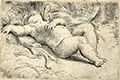
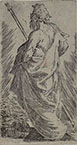
One of the most important and sensitive practitioners of Mannerism and one of the period’s finest draftsmen and innovative printmaker, Parmigianino was born in Parma to a family of artists. Taken under the care of his uncles, he learned painting from them at a young age. In just his early twenties, Parmigianino had already executed frescos in the church of San Giovanni Evangelista in Parma, contemporaneously with Correggio’s great murals on the dome and pendentives of that church, and decorated the ceiling of a room in the Rocca Sanvitale at Fontanellato with The Legend of Diana and Actaeon. After the summer of 1524, Parmigianino moved to Rome, taking with him three specimens of his work to impress the pope, including the famous self-portrait that he had painted on a convex panel from his reflection in a convex mirror. His chief painting done in Rome is the large Vision of St. Jerome (1527). Although this work shows the influence of Michelangelo, it was Raphael’s ideal beauty of form and feature that influenced his entire oeuvre. While at work on the Vision of St. Jerome, he was interrupted by soldiers of the imperial army taking part in the sack of Rome, and he left for Bologna. He returned in Parma in 1531, where he was ordered to carry out the frescoes in the Basilica of Steccata, a duty from which he was exempted in 1539 due to non-fulfillment of contract, having not managed to finish the work. Worried about all his legal problems Parmigianino found refuge at Casalmaggiore, where he died a at the early age of 37 only a year later.