(Milan 1881 – 1946)
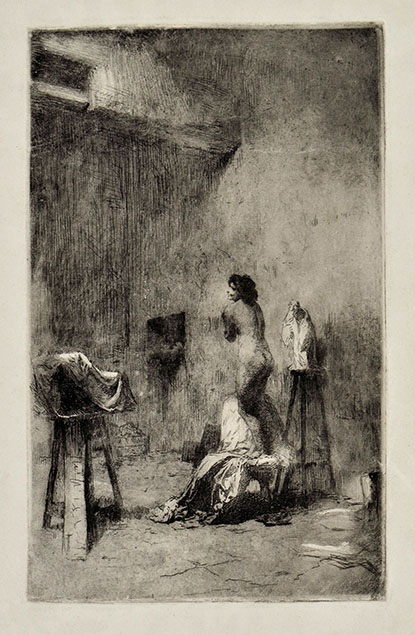
MODEL IN AN ARTIST'S STUDIO
Etching and aquatint, a fine impression in black ink, richly and skillfully printed working on the surface tone (acquaforte monotipata), on wove paper. To the platemark 250 x 155 mm, the full sheet 333 x 236
See another impression in the Biblioteca Panizzi, Reggio Emilia.
Giuseppe Palanti was a highly versatile Italian painter, illustrator, costume designer, and urban planner who became a prominent figure in the early 20th-century art scene. Born in Milan to a modest working-class family, he trained at the Scuola Superiore d'Arte Applicata under Luigi Cavenaghi before graduating from the prestigious Brera Academy, where he studied under masters Cesare Tallone and Giuseppe Mentessi.
For over a decade, Palanti collaborated closely with Milan’s world-renowned opera house, Teatro alla Scala. He designed intricate costumes, stage sets, and promotional posters for major productions, including landmark works by Puccini and Wagner. As a painter, he was celebrated for his Impressionist-influenced style, particularly his luminous landscapes and elegant portraits of women and children. His reputation as a portraitist earned him commissions from high-profile figures of the era, including Pope Pius XI and Benito Mussolini.
Beyond the canvas, Palanti was a visionary urban planner, playing a pivotal role in the design and development of the Adriatic seaside resort, Milano Marittima. He was also an accomplished and prolific printmaker who mastered the techniques of lithography, woodcutting, and etching. Significant examples of his activity as an etcher are preserved in the Panizzi library in Reggio Emilia