(Viddin 1885 - Paris 1930)
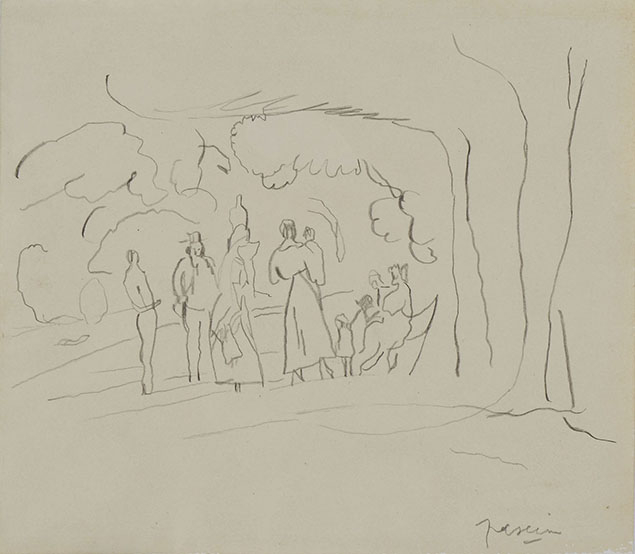
FIGURES IN A PARK
Black chalk, signed Pascin bottom right. 178 x 204 mm.
Born into a Sephardic Jewish family in Vidin, Bulgaria on 31 March 1885, Julius Pinkas, otherwise known as Jules Pascin, was brought up in Bucharest, where his earliest drawings were made surreptitiously in a local brothel. The female body remained a constant throughout his artistic career: casually posed, nude or partially dressed. Pascin was educated in Vienna and Munich. He moved to Paris in 1905 and contributed to the German satirical magazine Simplicissimus. His first paintings demonstrated the influence of the French Post-impressionist school and the Fauves. Despite exhibiting at the Salon d’Automne and Salon des Indépendents, Pascin became depressed over his lack of critical success, enrolling at the Académie Colarossi in Paris and spending hours copying Old Masters in the Louvre. In 1914, Pascin must leave Paris because of his Bulgarian nationality, and he leaves for the United States, and sets up in New York where he takes American nationality. In New York Pascin was part of the artists’ circle based around the Penguin Club. Set up by Walter Kuhn in 1916 in a modest East 15th Street brownstone, it hosted weekly drawing classes, exhibitions and an annual ball. In 1920 he returned to France and became closely associated with the École de Paris circle of Chagall, Modigliani and Soutine. In Paris, on 1 June 1930, on the eve of his first solo exhibition, tormented by depression and alcoholism, Pascin took his own life.