(Livorno 1825 - Florence 1908)
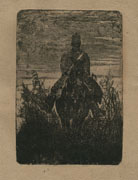
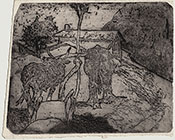
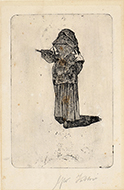
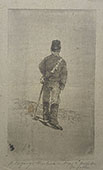
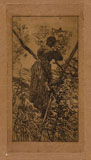
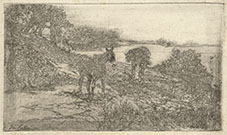
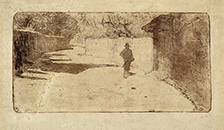
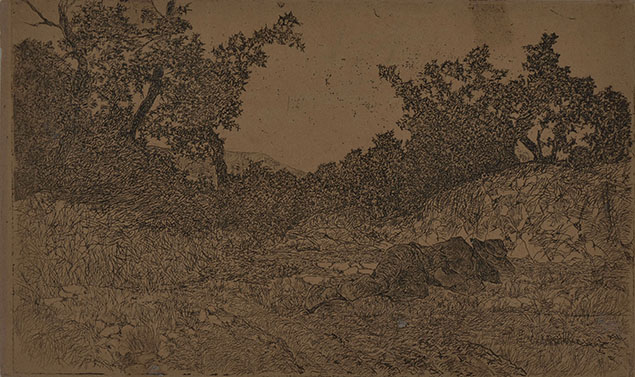
LA SIESTA
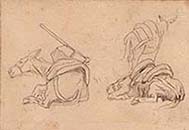
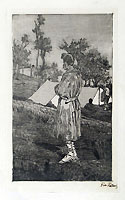
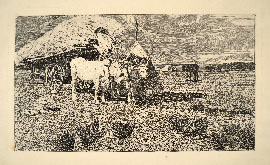
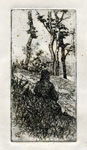
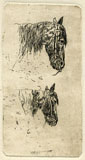
Zinc etching. Baboni-Malesci LXXXVI
Printed on brownish paper, this impression features a delicate tone, where a thin film of ink was deliberately left across the figure of the sleeping boy.
This specific print exhibits all the hallmarks of an impression pulled by Fattori himself, or executed under his direct supervision using his small hand press. Fattori typically printed these proofs on miscellaneous, often discarded papers, which he occasionally used to wrap and identify his plates.
Several comparable examples are preserved in the Franconi Collection.
Literature. See: Andrea Baboni, Le incisioni di Giovanni Fattori nella collezione Franconi, Florence, 1987; nos. 4, 26, 28, 64, 74, 78, and 85.
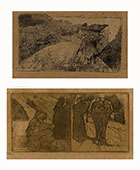
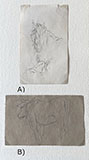
On the verso traces of old adhesive tape and indistinct handwriting.
To the platemark 148 x 246 mm
Giovanni Fattori, possibly the most important painter of the nineteenth century in Italy, received his first instruction in drawing from a lesser painter of his native town. In 1846 Fattori moved to Florence to attend the Academy. During the 1850s Fattori joined the innovative artists, called Macchiaioli, who met at the Caffè Michelangelo in Florence and were champions of a new technique and style to contrast the conventional academic language. During those years, he still produced works that could be attributed to the historical-romantic school but his interest in studying from life also extended to landscape painting and the military life of the day became the subject of his first experiments in painting using the macchia technique. In 1867, after the death of his first wife, Fattori frequently stayed in the Maremma region which became the ideal backdrop for his works. Fattori began etching in the early 1880s, when he was nearly sixty; quite soon he was able to appreciate the difference of expression he could achieve using this new medium. A real peintre-graveur, he continued with etching his artistic research on light and essential shapes in reality.