(Stampa 1868 - Glion 1933)
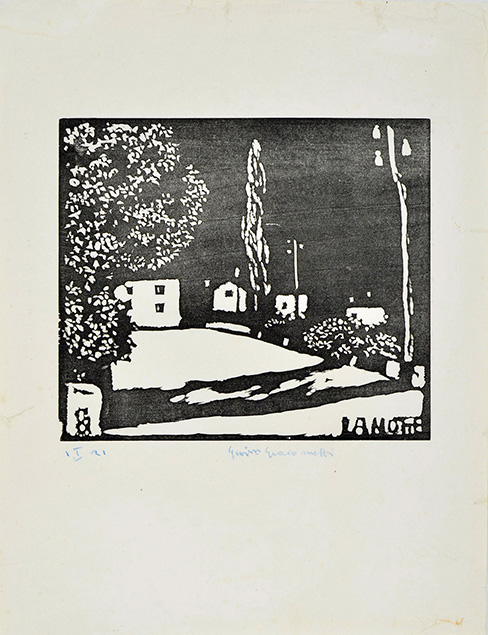
LA NOTTE, 1921
Woodcut. Stauffer 34. Impressed with black ink on wove paper. Dated 1.I.21 and signed Giovanni Giacometti in blue pencil on the lower margin. To the image 198 x 229 mm, the full sheet 393 x 304 mm.
Giovanni Ulrico Giacometti was a distinguished Swiss painter known for his profound influence on the art world and his legacy as the father of renowned artists Alberto and Diego Giacometti, as well as architect Bruno Giacometti. Born as the fourth of eight children to a baker father named Alberto, who also ran a café, creativity ran deep in the Giacometti family; notably, painter Augusto Giacometti was his cousin.
Giacometti received his early education in Chur, where a passion for art was ignited by the encouragement of a supportive teacher. In pursuit of his artistic dreams, he relocated to Munich in 1886 to attend art school. It was in Munich that he crossed paths with Cuno Amiet, a friendship blossoming between the two as they delved into the works of the French Impressionists.
With parental backing, Giacometti and Amiet moved to Paris in 1888, where they participated in the Salon de la Spring. This experience left a lasting impression on him, introducing him to the transformative artistry of Gianni Segantini, who he would later meet personally. However, financial constraints forced Giacometti to return to his hometown of Stampa in 1891—a period marked by solitude and creative struggle.
Despite these hardships, a breakthrough came with the exhibition of his early works at the "Nationale Kunstausstellung" in Bern, combined with a commission for a portrait, which provided him with some financial relief. With his newfound resources, Giacometti traveled to Rome and Naples, absorbing the cultural richness around him. In 1894, he encountered Segantini, leading to a profound friendship that lasted until Segantini's death.
In 1897, Segantini envisioned a grand panorama of the Engadine for the Swiss pavilion at the 1900 World's Fair in Paris, in which Giacometti was meant to collaborate, yet the project faltered due to lack of funding. In 1900, Giacometti married and settled in Borgonovo, where he welcomed his first son, Alberto, in 1901, followed by three more children. This period signifies a pivotal turn in his artistic journey, as he began to assert his individuality, drawing inspiration from French artists and gradually breaking free from the substantial influence of Ferdinand Hodler.
In 1912, Giacometti was honored with an invitation to exhibit alongside the "Brücke" artists in Dresden. That same year saw him achieve significant acclaim from an exhibition at the Kunsthaus Zurich, followed by a successful showing of his works in Bern in 1920. He continued to gain recognition through multiple international solo exhibitions.
In the final years of his life, Giacometti found solace in the tranquility of Stampa, where he continued to create, leaving behind a legacy that would influence generations of artists to come.