(Milan 1889 - San Miniato (Pisa) 1966)
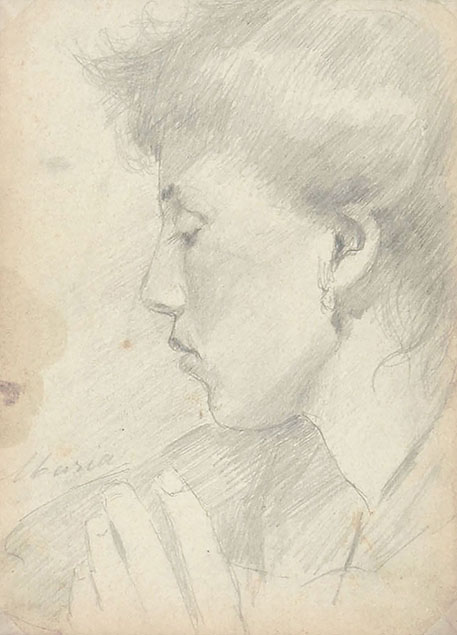
PORTRAIT OF MARIA, THE ARTIST'S SISTER, 1910-1920
Pencil; inscribed Maria; 200 x 150 mm. The drawing, strongly influenced by Lombard naturalism and the example of Cesare Tallone, Gajoni's master at Brera, is to be dated around 1910-20.
Gajoni trained in Milan, studying under Cesare Tallone at the prestigious Brera Academy and attending the School of Applied Arts at the Castello Sforzesco. During this formative phase, he built a solid reputation as a skilled frescoist and muralist. He completed numerous public works, frescoes, and altarpieces across the provinces of Milan, Como, Varese, and Pavia, while regularly exhibiting at the Società per le Belle Arti ed Esposizione Permanente.
In 1928, Gajoni moved to Paris, immersing himself in the vibrant cultural hub of the École de Paris. He became closely integrated with the renowned group "Les Italiens de Paris", sharing deep artistic and spiritual ties with masters such as: Giorgio de Chirico, Alberto Savinio, Gino Severini, Filippo de Pisis, Mario Tozzi, Massimo Campigli. During this decade, he exhibited at the Salon des Indépendants. In 1933, he was awarded a prize at the Italian Art Exhibition in Paris. From 1935, he taught fresco technique at André Lhote’s Academy. Between 1933 and 1934, he assisted Gino Severini in creating the monumental mural decorations for the Basilica of Notre-Dame du Valentin in Lausanne. Following the outbreak of World War II, Gajoni repatriated to Italy and settled permanently in San Miniato, Tuscany. This relocation marked a highly prolific period dedicated to sacred art. He became one of the most sought-after fresco painters in the region, decorating dozens of local churches. Parallel to his public commissions, he maintained a steady production of easel paintings and drawings until his death in 1966.