(Amsterdam c. 1601 – c. 1647/1657)
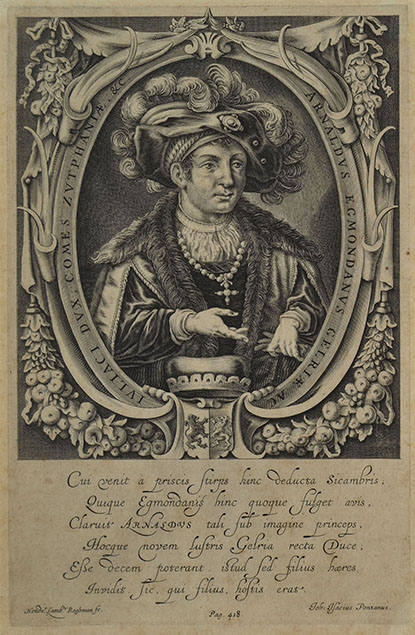
PORTRAIT OF AARNOUT VAN EGMOND, 1639
Engraving, created for the historical work Historiae Gelricae libri XIV by the historiographer Johannes Isacius Pontanus, published in Harderwijk by Nicolaes van Wieringen in 1639.
Hollstein, Dutch and Flemish, part 20 (1978), p. 62, no. 2.
Very good impression and condition, to the plate-mark 290 x 187 mm, the full sheet 300 x 195.
Roghman's 17th-century portrait asserts van Egmond's wealth, leadership, and aristocratic status within Dutch society. His noble lineage is highlighted through several key visual elements. Lavish attire: a fur-lined coat, feathered hat, and heavy jeweled necklace.
Heraldry and text: an ornate oval frame, a coat of arms at the base, and a Latin inscription referencing his ancestry. Overall, the artwork exemplifies how 17th-century portraiture was used to solidify social identity and hierarchy.
Roghman was a Dutch Golden Age engraver and printmaker active in Amsterdam, best remembered as the head of a notable family of 17th-century Dutch artists.
He likely trained under the prominent printmakers Herman or Jan Muller. Beyond engraving, he was also known as a poet who occasionally wrote Dutch verses to accompany his prints.
In 1623, he married Maria Savery, connecting himself to an influential artistic dynasty—she was the daughter of painter Jacob Savery and the niece of the famous landscape painter Roelant Savery. Hendrik ran a workshop in Amsterdam where he trained his three children, all of whom became accomplished artists in their own right: Geertruydt (an acclaimed engraver known for her depictions of women's domestic work), Roelant (a prolific landscape painter, etcher, and friend of Rembrandt), and Magdalena (an engraver).